Trane Furnace Error Codes in Burbank, CA
The homeowner answer: Burbank Trane HVAC reads Trane furnace error codes across Burbank, CA, from Magnolia Park to Burbank Hills in ZIP 91505, where the control-board LED blinks a repeating count that names the failed link in the ignition chain. Call (213) 805-8137 or book online to schedule a Trane tech.
Quick facts
- Trane and American Standard furnaces share the same flash-code table.
- Code is a blinking LED count at the door sight glass, not a screen.
- 2 = lockout, 3 = pressure/draft, 4 = open limit, 7 = gas valve, 8 = flame sense, 9 = igniter.
- Most Burbank furnace-code repairs run $150-$700 in 2026.
- A 6-flash rollout or cracked heat exchanger is a safety replacement.
- Service ZIPs: 91501, 91502, 91504, 91505, 91506, 91523. Hours: Weekdays 7am-6pm, weekends 8am-2pm.
- Independent; in-warranty boards referred to the authorized dealer first.
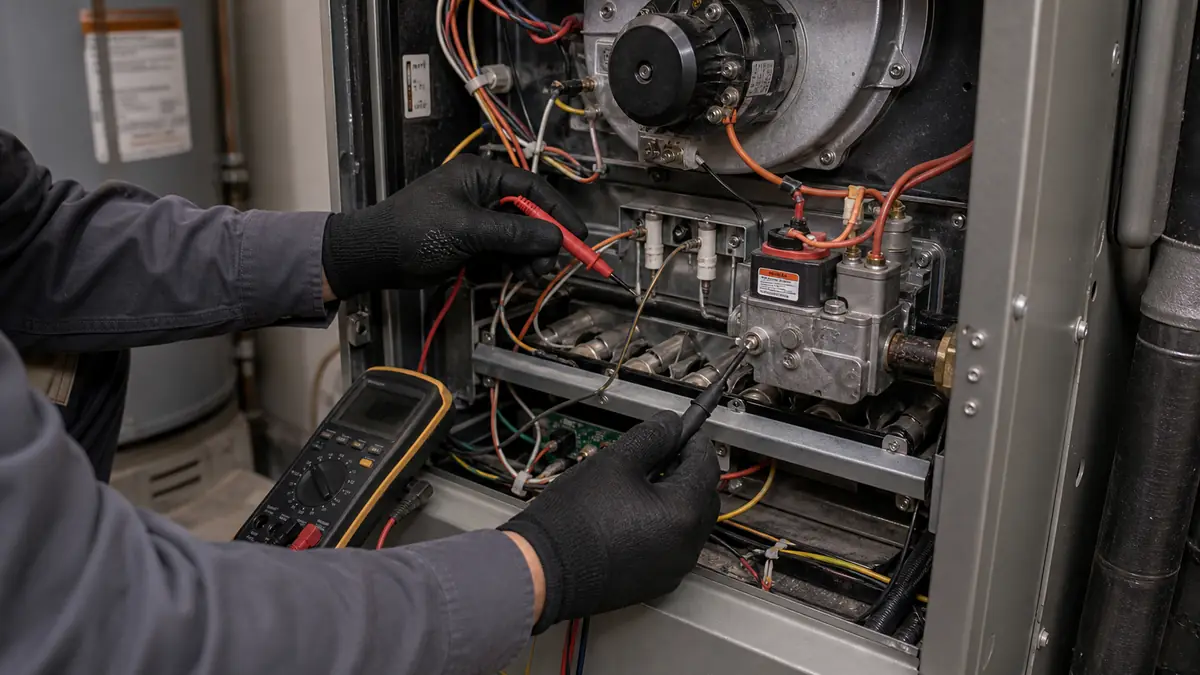
What do Trane furnace error codes actually tell you?
A Trane furnace does not have a fault screen. It has a single LED on the integrated furnace control (IFC) behind the burner door, and that LED blinks a repeating count: three blinks, a pause, three blinks again is a 3-flash code. The number is not a vague "check engine" light - it points at one specific link in a fixed ignition sequence. On a heat call the inducer spins up, the pressure switch proves draft, the hot-surface igniter glows, the gas valve opens, and the flame sensor confirms fire. Every step has to pass before the next is allowed. When one step fails, the board cuts gas and parks the matching flash count so the next person knows exactly where the chain broke. That is the whole point of reading the code first: it turns a "the furnace is dead" call into "the pressure switch never closed," which is a different part, a different test, and a different bill.
One Burbank-specific quirk drives a lot of these calls: furnaces here barely run. Title-24 Climate Zone 9 on the southeastern San Fernando Valley floor means short, mild winters - a Trane furnace in a Magnolia Park bungalow might log only a few dozen burner hours a year. Parts that sit idle from March to November corrode and seize, so the first hard cold morning is when igniters crack, flame sensors haze over, and pressure switches stick. The code you see in December is usually a part that failed quietly back in summer.
| Flash code | Meaning | First check | Typical cost lane |
|---|---|---|---|
| 2 flashes | System lockout (ignition retries exceeded) | Igniter, flame sensor, gas supply | $150 - $400 |
| 3 flashes | Vent / pressure-switch error (no proven draft) | Inducer, switch, flue, sensing tube | $150 - $700 |
| 4 flashes | Open high-temperature limit (overheat) | Filter, returns, blower - airflow | $120 - $600 |
| 5 flashes | Flame sensed when none expected | Gas valve leak-by, control board | $400 - $900 |
| 6 flashes | Reversed polarity / poor ground / rollout | Line wiring, ground, rollout switch | $80 - replace |
| 7 flashes | Gas-valve circuit error | Gas valve, valve wiring, board | $80 - $700 |
| 8 flashes | Low flame-sense signal | Dirty or weak flame sensor | $150 - $350 |
| 9 flashes | Igniter circuit / 24V common fault | Cracked hot-surface igniter | $150 - $400 |
That table covers the gas-furnace codes Burbank homes throw most. The two we get called on hardest each fall are the 3-flash vent and pressure-switch error and the 7-flash gas-valve circuit error - each has its own deep walkthrough below the chart.
How do you read codes on a Trane furnace?
Find the burner-access door low on the furnace cabinet. Most Trane gas furnaces have a small clear sight glass in that door; the IFC LED blinks behind it, and on units without a glass you pop the lower panel to see the board directly. Set the thermostat to call for heat, then watch the LED through a full cycle. Count the blinks in one group, note the pause, and confirm the count repeats - that repeating number is the code. A slow steady on/off (about one per second) usually means normal operation or "no call," not a fault. A rapid continuous flutter often means the board lost line power or has a hardware fault of its own.
Two things trip people up. First, Trane and American Standard furnaces run the same Ingersoll Rand control boards, so any American Standard flash chart reads identically on a Trane - handy if the homeowner only has the other brand's manual. Second, the printed legend is on a label inside the burner door; if it is faded, the count still maps to the table above. Write down the count before you cut power, because killing the switch clears the latched code and you lose the evidence.
Which Trane codes are common in Burbank homes?
The housing stock shapes which faults show up. Burbank's 1920s-1940s Spanish and Tudor cottages and post-war ranch tracts often have furnaces tucked in tight closets, low attics, or garages, with long or restrictive return paths. That feeds two patterns. Restricted airflow drives 4-flash open-limit trips - a filter nobody changed over a mild winter, or undersized returns in an older cottage. And venting that runs through a long attic or a shared masonry chase drives 3-flash pressure-switch faults, especially when a sensing tube cracks or a bird screen at the termination clogs. In the post-war ranch homes with the furnace in the garage, line-voltage and grounding issues show as 6-flash polarity codes after a previous outlet swap. The 7-flash gas-valve and 8-flash flame-sense codes track age more than location: low annual runtime means the valve and sensor corrode slowly and finally read out of range on a cold December morning.
How do you fix a Trane furnace error code?
We fix the link the code names, not the whole furnace. A 9-flash igniter reads infinite resistance on a meter and gets a new hot-surface igniter. An 8-flash low flame-sense reads near-zero microamps; a careful clean or a new sensor restores the few microamps of rectified current the board needs to keep the valve open. A 3-flash means we meter the pressure switch, then inspect the inducer, flue, and sensing tube for the real blockage behind it - the switch is rarely the actual failure. A 7-flash sends us to the gas-valve circuit: we check the valve coil, the harness, and the board's drive signal. A 4-flash is an airflow job - filter, returns, blower wheel, and ECM - not a burner job. The diagnostic that locates the failed link runs about $139 and is usually credited toward the repair. The one code we never "patch" is a 6-flash that traces to a rollout switch and a cracked heat exchanger: that furnace is replaced, because it is a carbon-monoxide risk, and any new gas furnace in California has to meet Ultra-Low NOx rules. Our furnace repair page covers parts and labor in more detail, and the repair-or-replace guide covers the age thresholds.
When is a flashing Trane furnace an emergency?
Most codes are a same-week repair, not a 2am crisis - a no-heat furnace on a mild Burbank night is uncomfortable, not dangerous. The exceptions are about combustion safety, not cold. Any gas smell, a 6-flash rollout code, a burnt or hot-metal odor, or soot at the furnace means shut it off at the switch and call now; those point at flame rollout or a cracked heat exchanger. If a vulnerable household loses heat during an actual cold snap, that moves up the queue too - see emergency service in Burbank for same-day and weekend triage. For everything else, read the flash count, call (213) 805-8137 or book online with the number in hand, and we bring the right part the first time.
Common questions about Trane furnace error codes in Burbank
Where do I read the error code on a Trane furnace?
Read it at the small sight glass on the furnace door or just inside it - a red or green LED on the integrated furnace control (IFC) blinks a repeating count. Two flashes, pause, two flashes is a 2-flash code. Note the exact count before resetting power; that number is the whole diagnosis.
Are Trane and American Standard flash codes the same?
Yes. American Standard and Trane furnaces share the same Ingersoll Rand control boards, so the flash-code table is identical. A 3-flash on a Trane XV95 means the same vent/pressure-switch fault as a 3-flash on the American Standard equivalent. The codes also carry over to many Trane variable-speed and two-stage gas furnaces.
Does resetting power clear a Trane error code for good?
Only briefly if the cause is still there. Killing power at the switch clears the latched code and the furnace will retry, but a 4-flash limit or 3-flash draft fault returns within a cycle or two because the airflow or venting problem is unchanged. A reset is a test, not a repair.
How fast can you get to a no-heat Trane in Burbank?
Most Burbank no-heat calls get same-week service, and we hold weekend hours on the first cold snaps of the season. Read the flash count, give us the number when you call (213) 805-8137 or book online, and we load the right part - igniter, flame sensor, pressure switch, or gas valve - before we roll.