Trane Furnace 3 Flashes in Burbank, CA
The homeowner answer: Three flashes on a Trane furnace in Burbank, CA (ZIP 91504) is a vent or pressure-switch error - the inducer never proved draft, so call before you keep resetting it; the usual cause is a blocked flue, weak inducer, cracked sensing tube, or plugged condensate trap. Book online or call (213) 805-8137 and we test the draft circuit.
Quick facts
- 3 flashes = vent / pressure-switch error: the furnace cannot prove draft.
- Usual causes: weak inducer, blocked flue, cracked sensing tube, plugged condensate trap.
- The pressure switch is usually the messenger, not the failed part.
- Inducer about $300-$700; pressure switch about $150-$350; flue/trap clearing within a visit.
- The lockout is a safety - do not bypass it; spilled flue gas can carry carbon monoxide.
- Service ZIPs: 91501, 91502, 91504, 91505, 91506, 91523. Hours: Weekdays 7am-6pm, weekends 8am-2pm.
- Diagnostic about $139, usually credited toward the repair.
What does 3 flashes mean on a Trane furnace?
Three flashes is a vent or pressure-switch error. In plain terms: the furnace tried to start, the inducer motor spun up to pull combustion air through the burners and push flue gas out the vent, and the pressure switch that is supposed to confirm that draft never closed - or it opened mid-cycle. Because the board has no proof that exhaust is actually leaving the house, it refuses to light the burners and parks the 3-flash code. That refusal is the safety working exactly as designed. The pressure switch is a simple diaphragm device connected by a thin rubber sensing tube to the inducer housing; when the inducer creates the right negative pressure, the diaphragm pulls a set of contacts closed and tells the board "draft is proven." A 3-flash means that handshake failed. The trap to avoid is blaming the switch itself - nine times out of ten the switch is honest and something upstream (a blocked flue, a tired inducer, a kinked tube, or a flooded condensate trap) is the real reason draft never developed.
Why does a Trane furnace throw 3 flashes in Burbank homes?
The valley floor and the housing stock conspire here. Burbank sits in Title-24 Climate Zone 9, a southeastern San Fernando Valley heat pocket, so furnaces run very few hours a year. A furnace that only fires on a few dozen cold mornings has an inducer motor whose bearings stiffen and a sensing tube that hardens and cracks while sitting idle from spring through fall. When the first real cold morning arrives, the inducer drags, spins slow, and never builds enough negative pressure to make the switch.
Venting geometry is the other half. The 1920s-1940s Spanish and Tudor cottages and post-war ranch tracts around Magnolia Park and Burbank Hills often have the furnace in a closet, low attic, or garage, with the flue running a long, twisty path through an attic before it reaches the roof. Long horizontal runs accumulate debris, rodent nests, and the occasional bird's nest at the termination, and they sag at joints. On 90%-plus condensing furnaces the picture adds a condensate trap and drain: when that trap plugs with the fine biofilm that builds over a dry summer, water backs up into the pressure-switch tubing and a 3-flash appears the moment the system tries to run. Cold, damp morning air makes all of this worse, which is why so many 3-flash calls come in before 9am and seem to "fix themselves" by noon.
How do you diagnose a 3-flash draft fault step by step?
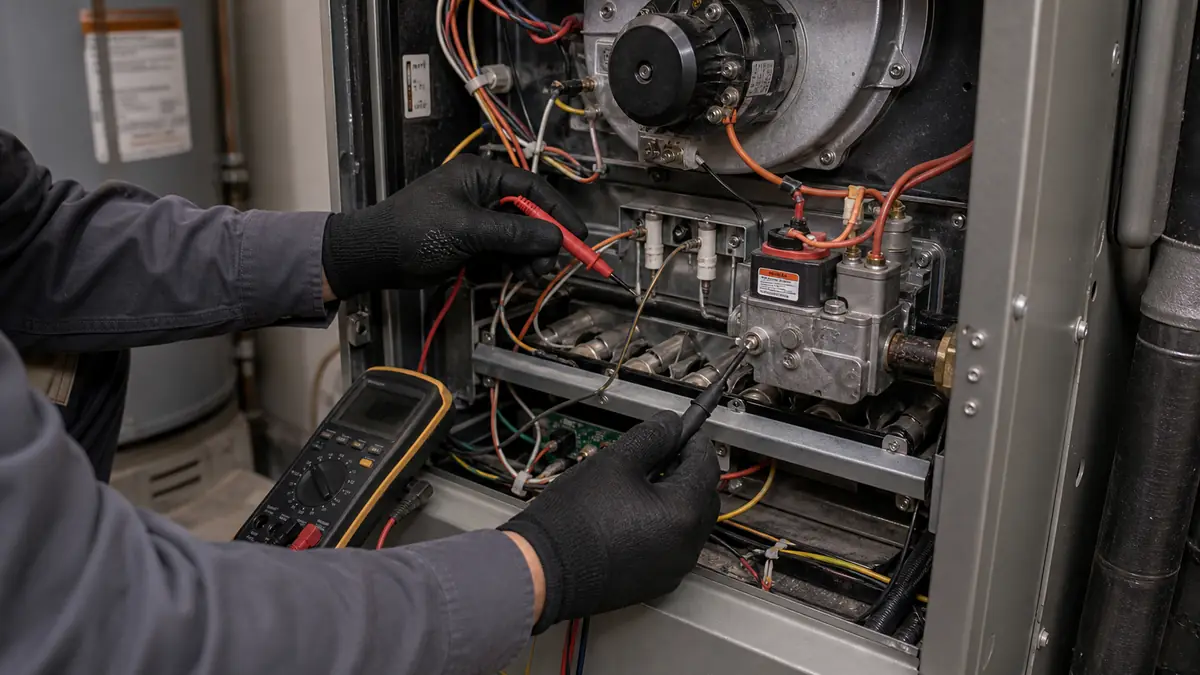
We test the draft circuit cold, in the order the furnace itself checks it, with a manometer and a multimeter on the bench at the burner door.
- Confirm the code and the call. Watch the LED through one cycle to verify a clean repeating 3-flash, then confirm the inducer actually energizes on a heat call.
- Watch and listen to the inducer. A healthy inducer spins up fast and quiet. A slow, growling, or wobbling inducer is the failure - we read its winding and its capacitor if it has one, and check for play in the shaft.
- Measure real draft. We tee a manometer into the pressure-switch port and read the actual negative pressure in inches of water column against the switch's stamped set point. If the inducer cannot pull the rated vacuum, the problem is upstream of the switch.
- Inspect the sensing tube. The thin rubber tube is pulled and checked for cracks, soot, condensate, and kinks. A tube full of water from a backed-up trap is a frequent Burbank find.
- Trace the flue and trap. We look at the full vent run for blockage, sag, a clogged termination screen, and on condensing units a plugged condensate trap and drain line.
- Test the switch last. Only after the draft itself proves good do we bench the pressure switch - jumping it briefly to confirm the board fires, then replacing the switch if it will not close at proper vacuum. We never leave it jumped; that defeats the safety.
Reading the draft this way means we replace the part that actually failed - usually the inducer or a blockage, sometimes the switch - instead of throwing a switch at it and calling back next week.
What can I safely check before calling on a 3-flash?
A short, safe homeowner list, and a hard stop. Set the thermostat to heat above room temperature and confirm the furnace switch and breaker are on. Change the air filter if it is gray and packed - low airflow can compound draft trouble. Look at the vent termination outside (on the roof or a sidewall) for an obvious bird's nest, leaves, or a wasp's nest you can clear from the ground. On a high-efficiency furnace, check whether the condensate drain is overflowing or the floor near the furnace is wet, which hints at a plugged trap. That is the safe boundary. Do not pull the sensing tube, jump the pressure switch, open the inducer housing, or run the furnace with the lockout defeated - the 3-flash is refusing to burn gas precisely because it cannot prove the exhaust is leaving the building, and overriding that can spill combustion gas, including carbon monoxide, into the home. If a fresh filter and a clear termination do not bring it back, the fault is inside the draft circuit and needs a manometer.
What does a 3-flash repair cost, and when is it urgent?
Cost tracks the actual cause. Clearing a plugged condensate trap, freeing a kinked or water-filled sensing tube, or pulling a flue obstruction often falls inside the roughly $139 diagnostic visit. A failed pressure switch runs about $150 to $350 installed. A weak or seized inducer motor and assembly - the most common real failure on these low-runtime Burbank furnaces - runs about $300 to $700 installed. If the furnace is past about 18 years and needs an inducer plus other parts, the repair-or-replace math can tip toward a new system, and any new gas furnace in California must meet Ultra-Low NOx rules. On urgency: a 3-flash itself is a safe lockout, not a 2am emergency, so a same-week visit is usually right. It moves up the queue if a vulnerable household has no heat in a genuine cold snap - see emergency service in Burbank. If you also smell gas or exhaust, or see soot, shut the furnace off at the switch and call (213) 805-8137 now. For the full code chart, go back to the Trane error-code hub, and the furnace repair page covers the rest.
Common questions about a Trane 3-flash in Burbank
Can I reset a Trane furnace 3-flash code myself?
You can cycle power at the furnace switch to clear the latched 3-flash, and it is worth one try after you change a clogged filter. But a draft fault that returns within a cycle or two means the inducer, flue, sensing tube, or condensate trap is still blocked. Resetting does not fix a venting problem; it just restarts the same failed proving test.
Is a 3-flash Trane furnace dangerous to run?
The 3-flash safety is actually protecting you - the furnace refuses to fire because it cannot prove the flue is drawing combustion gases outside. That lockout is good. The danger would be defeating it. Leave the switch off and call; running a furnace that cannot prove draft risks spilling combustion byproducts, including carbon monoxide, into the house.
Why does my furnace throw 3 flashes only in the morning?
Cold, dense morning air and condensation are the trigger. Overnight the flue cools, moisture collects in the sensing tube or condensate trap, and the pressure switch cannot make on the first cold call. As the day warms and the system dries out it may run fine - which is exactly why we test the draft circuit cold, when the fault actually appears.
What does a 3-flash repair cost in Burbank?
Most 3-flash repairs in Burbank run $150 to $700. Clearing a plugged condensate trap, freeing a kinked sensing tube, or clearing a flue obstruction lands at the low end, often within the diagnostic visit. A failed pressure switch is roughly $150 to $350, and a replacement inducer motor and assembly runs about $300 to $700 installed.