Trane Buying Guide for Burbank Homes (2026)
Last updated: 2026-06-13
The homeowner answer: This guide from Burbank Trane HVAC helps Burbank, CA homeowners size and pick a Trane system - SEER2 tiers, XR vs XL vs XV, and Title-24 Climate Zone 9 rules for a Magnolia Park home in ZIP 91505. Call (213) 805-8137 or book online to schedule a load assessment.
Quick facts
- A Manual J load calc - the industry-standard sizing method - sizes a unit right; the square-foot rule oversizes it.
- DOE Southwest floors: split AC 14.3 SEER2 / 11.7 EER2 (13.8 / 11.2 at 45,000 BTU and up); split heat pump 14.3 SEER2 with 7.5 HSPF2.
- Burbank is cooling-dominant Title-24 Climate Zone 9, where HERS field verification kicks in.
- Trane tiers: XR (value), XL18i (two-stage), XV18/XV20i (variable-speed, up to ~20.5 SEER2).
- Budget for a Burbank install: $5,000-$12,000 for central AC, $6,000-$16,000 for a heat pump, in 2026 SoCal dollars.
- The federal 25C credit was repealed as of 12/31/2025; check any local utility rebate amount yourself.
- Independent install and design.
How do I size a Trane system for a Burbank home?
Get the size wrong and comfort is gone before the first hot day, and around here it gets botched more than anything else on the job. Valley crews spent decades reading square footage, rounding up, and bolting an oversized condenser onto a small Burbank cottage - so it dumps cold air, hits the thermostat in a few minutes, then short-cycles through the whole summer, never holding humidity down. The cure is a Manual J load calculation, the method the trade treats as standard, because it weighs what actually loads the house: insulation, the area and facing of the windows, air leakage, ceiling height, and shade.
A typical well-shaded 1,100-1,400 square-foot Magnolia Park or Chandler Park bungalow often lands at 2 to 2.5 tons - noticeably less than the 3-plus tons frequently quoted. Get the number right and the system runs longer at lower output, holds temperature evenly, and pulls humidity. Get it wrong on the high side and you buy short cycling, uneven rooms, and early capacitor and compressor wear. Larger Burbank Hills rebuilds and bigger Toluca Lake-adjacent homes legitimately need more capacity; the point is to calculate, not assume.
What does a Manual J actually weigh, and why does oversizing fail?
A Manual J load calculation adds up where heat actually enters a Burbank house and subtracts where it leaves, instead of multiplying square footage by a rule of thumb. The big inputs are the area and orientation of the glazing (a west-facing wall of single-pane windows on a 95 F afternoon is a huge gain), insulation levels in walls and the attic, air leakage through a leaky 1930s envelope, ceiling height, and crucially the shade a mature street tree or a north-facing lot provides. Two identical-footprint cottages can land a half-ton apart purely on glass and shade. That precision matters because oversizing sets off a predictable failure chain: an oversized condenser drives the room to setpoint in two or three minutes, satisfies the thermostat, and shuts off before it has run long enough to pull moisture out of the air - so the house feels cold and clammy at once. The rapid restarts hammer the compressor at its highest-stress moment and burn capacitors out early, and the short runs leave back bedrooms uneven because the air never circulates fully. The fix is never a bigger unit; it's the right-sized unit running longer at lower output.
A worked sizing example: a 1,250 sq ft Magnolia Park bungalow
Walk a typical case. A 1,250 square-foot 1930s Magnolia Park bungalow, decent attic insulation added later, moderate west glass, and a big shade tree out front. A square-foot rule at the old 500-600 sq ft per ton lands a contractor at 3 tons and a quick upsell to 3.5. A Manual J that credits the shade and the modest glass usually comes in near 2 to 2.5 tons. Drop in the 3.5-ton unit and you get the clammy, short-cycling result above plus early capacitor failures on the valley floor. Match the 2.5-ton load with a two-stage XL18i and the system runs long, low-stage cycles that hold temperature within a degree and actually dehumidify - and it costs less to buy than the oversized unit it replaces. The lesson generalizes: on Burbank's small, often-shaded pre-war lots, the honest number is almost always smaller than the quote, and the only way to know is to calculate it.
XR, XL, or XV - which Trane tier fits?
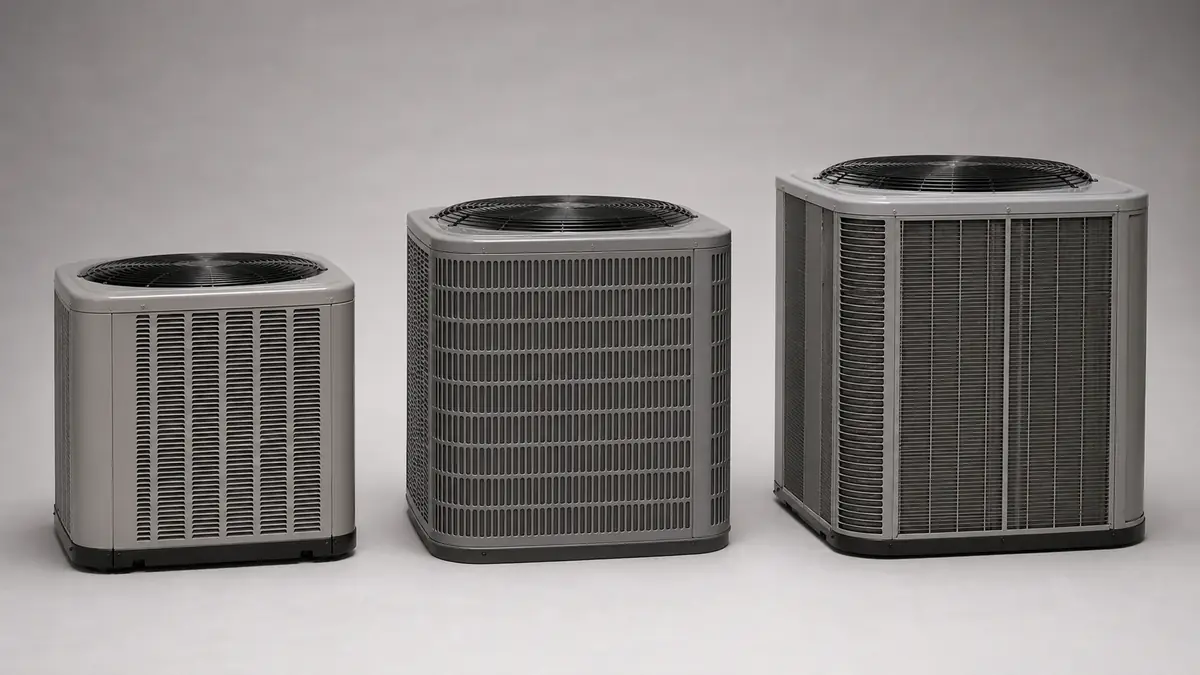
Trane stacks its residential lineup by how the compressor stages. The single-stage XR series (XR13 through XR17) is the durable value workhorse: full-on or off, widely stocked, lowest cost. The XL18i adds two-stage Climatuff cooling for longer, gentler runtimes. The XV18 and flagship XV20i modulate continuously with a variable-speed Climatuff compressor for the tightest control and highest efficiency, up to about 20.5 SEER2. All of the XL and XV communicating models need a ComfortLink II control to do their job.
| Tier / models | Staging | Best fit in Burbank | Installed lane |
|---|---|---|---|
| XR13-XR17 (single-stage) | One speed | Small budget-minded cottages | $5,000 - $8,500 |
| XL18i (two-stage) | Low / high | Sealed small-to-mid homes - value sweet spot | $7,000 - $10,500 |
| XV18 (variable-speed) | Modulating | Mid homes wanting quiet, even comfort | $8,500 - $12,500 |
| XV20i (variable-speed) | Modulating, up to ~20.5 SEER2 | Larger / hillside rebuilds, big swings | $10,000 - $14,000 |
Compare the two communicating tiers directly on the XL18i page and the XV20i page.
What does SEER2 mean, and what's the SoCal minimum?
SEER2 is today's efficiency yardstick, running since the DOE 2023 standards took hold on January 1, 2023, and it is measured against a tougher external static pressure than the old SEER ever was. For cooling, no region is stricter than the DOE Southwest, and California lives in it. Here the split-system floors read like this: a split AC under 45,000 BTU has to make 14.3 SEER2 / 11.7 EER2, a split AC at 45,000 BTU or larger drops to 13.8 SEER2 / 11.2 EER2, and a split heat pump has to clear 14.3 SEER2 alongside 7.5 HSPF2. Those are minimums only - the XV20i runs well clear of them. Codes get revised, so verify the live floor for your equipment class before you buy.
| SEER2 range | Typical Trane match | Trade-off on the valley floor |
|---|---|---|
| ~14.3 (code minimum) | XR14 / XR15 | Lowest upfront; higher summer runtime cost |
| ~16-17 | XR16 / XR17, XL18i | Solid efficiency for 40-55 hot days/yr |
| ~18-20.5 | XV18 / XV20i | Best comfort and efficiency; premium cost |
What does Title-24 require when I install in Burbank?
Burbank lands in cooling-dominant Title-24 Climate Zone 9, and the state energy code piles its own demands on top of the federal equipment floors. Swap a split system and you can plan on charge and airflow verification; touch the ducts and you trigger duct sealing with HERS field verification. The code keeps leaning harder toward heat-pump-ready and heat-pump-preferred baselines. Zones track CEC weather stations rather than the city line, so what actually triggers depends on your address and the code cycle in force - we pin both down before we quote you on compliance. Duct condition gets its own treatment on the ductwork page.
AC, heat pump, or keep the gas furnace?
Most Burbank homes still run a gas furnace paired with an AC condenser. A heat pump replaces both halves with one system that cools and heats, which suits the mild valley winters well and aligns with where California's code is heading. The downside is a higher install cost and the need for adequate electrical capacity. If your gas furnace is recent and healthy, a straight AC replacement is cheaper; if the furnace is also aging, a heat pump consolidates the decision. Any new gas furnace in California must meet Ultra-Low NOx rules.
Are there rebates or tax credits in 2026? (Read the caveats)
Tread carefully, because the incentive map got redrawn. The federal 25C Energy Efficient Home Improvement Credit ran at 30 percent of project cost with a $2,000 cap on heat pumps, and it was repealed effective December 31, 2025. You can still claim it on the 2025 return, but only for gear that was both bought and installed on or before that date - a 2026 install gets no federal 25C credit at all. If a salesperson works it into a quote for this year's job, walk it back.
Utility programs around here can still move the needle, though they cycle through funding rounds that pause and reopen and the dollar amounts keep shifting. LADWP has run heat-pump rebates reported up to a per-ton figure that scales with efficiency; SCE has put up roughly $1,000 per qualifying heat-pump HVAC system; SoCalGas has offered rebates on furnaces and smart thermostats. The statewide TECH Clean California single-family pot was reported fully reserved early in 2026. And note that BayREN and 3C-REN, which homeowners elsewhere lean on, do not reach LA County. Treat every number as unconfirmed until you read it on the program's own page for the current amount and status. We won't pin a rebate to your quote that we can't stand behind.
Gas furnace or heat pump - which for a Burbank winter?
The mild valley winter changes the math compared with colder regions. A Burbank furnace runs only a handful of cold mornings a year, so the case for an expensive high-AFUE modulating furnace is weaker here than it would be inland or up the coast. Meanwhile, an air-source heat pump cools and heats from one system and handles the gentle Burbank heating season with ease, which is why California's code keeps nudging toward heat-pump baselines. The trade-offs come down to upfront cost, electrical capacity, and whether your existing gas furnace still has life.
| Option | Trane match | Best when | Watch-out |
|---|---|---|---|
| Keep gas furnace, replace AC only | XR/XL/XV condenser + existing S-series furnace | Furnace is recent and healthy | Two systems to maintain long term |
| New gas furnace + AC | S9X1/S9V2 + XR/XL condenser | Both halves are aging | CA Ultra-Low NOx rules apply |
| Heat pump (cool + heat) | XV20i or XL heat pump | Want one system; electrification | Higher cost; needs electrical capacity |
If you lean toward a heat pump, the variable-speed details are on the XV20i page, and the two-stage middle ground is on the XL18i page.
What else affects the install - electrical, ducts, permits?
The equipment is only part of the job. Three things routinely change the scope on a Burbank cottage. First, electrical: a heat pump or a big condenser may need panel capacity an old 1930s service doesn't have, which adds an electrician to the project. Second, ducts: if a static-pressure test shows the existing returns can't move the air, you're sealing or resizing ductwork before the new system can hit its rating - skipping that step buys short cycling. Third, permits and verification: replacements in Burbank require permits, and Title-24 Climate Zone 9 typically triggers HERS field verification of duct sealing plus refrigerant-charge and airflow checks. We price these honestly up front rather than discovering them mid-job.
For a tight Magnolia Park or Chandler Park lot, condenser placement and clearance also matter - a unit crammed against a fence with no airflow room will run hot and fail early no matter how high its SEER2 rating.
Common questions about buying a Trane in Burbank
What size Trane AC does a Burbank bungalow actually need?
Less than the number on most quotes. Shade a 1,100-1,400 square-foot pre-war cottage properly and 2 to 2.5 tons usually covers it, not the 3-plus tons a square-foot guess sells. You get the honest figure from a Manual J load calculation - the industry-standard sizing method - which reads insulation, glazing, and shade. Skip it and oversize, and the unit short-cycles and never wrings out humidity.
Is the XR, XL, or XV Trane line right for my Burbank home?
For a small sealed cottage, an XR16 single-stage or XL18i two-stage is usually the value sweet spot. For a larger or hillside home with big temperature swings, the variable-speed XV18 or XV20i earns its premium with tighter control and higher SEER2. The deciding factor is load and duct capacity, not the badge.
What's the minimum SEER2 I can install in Burbank?
Burbank falls under the DOE Southwest region, which holds cooling equipment to the tightest floor in the country. A split AC below 45,000 BTU has to hit 14.3 SEER2 / 11.7 EER2; cross 45,000 BTU and the floor drops to 13.8 SEER2 / 11.2 EER2. A split heat pump owes you 14.3 SEER2 paired with 7.5 HSPF2. On top of those equipment floors, Climate Zone 9 Title-24 layers in duct sealing plus charge and airflow checks. Standards move, so pin down the current number for your exact equipment class before you sign.
Are there still rebates or tax credits for a Trane heat pump in 2026?
Local utility money might be on the table, but the federal side closed. Congress ended the 25C credit as of December 31, 2025, which leaves nothing federal for a 2026 install. LADWP and SCE have run heat-pump rebates in the past; those open and close in funding rounds and the dollar figures drift, so confirm the live amount and program status before you bank a single dollar of it.