Trane Furnace Repair in Burbank, CA
The homeowner answer: Burbank Trane HVAC repairs Trane furnaces across Burbank, CA from Magnolia Park to Burbank Hills in ZIPs 91501 to 91523, reading the control-board LED flash codes on XR95, S9V2, S9X1, and XV80 units - igniter, flame sensor, inducer, pressure switch, and gas valve faults - so call (213) 805-8137 or book online, with most repairs in the $150 to $1,200 lane.
Quick facts
- Trane furnaces serviced: XR80, XL80, XV80, XR95, S9X1, S9X2, S9V2, XV95, XC95m.
- Most Burbank cottages run an 80 percent furnace in a hall or closet, paired with a side-yard condenser.
- Diagnostic about $139; common furnace repairs run $150-$1,200 in 2026 SoCal.
- We diagnose by flash code, not by guessing parts.
- Service ZIPs: 91501, 91502, 91504, 91505, 91506, 91523.
- Hours: Weekdays 7am-6pm, weekends 8am-2pm.
- In-warranty Trane heat exchangers and parts referred to the authorized dealer first.
Why won't my Trane furnace heat in Burbank?
Nine times out of ten a dead Trane furnace is a stalled ignition train or a latched safety, nothing more. Every call for heat walks the same checklist: the inducer motor pulls a draft, the pressure switch has to feel that draft and close before anything else moves, the hot-surface igniter heats up, the gas valve releases fuel onto it, and the flame sensor reports back that combustion actually caught. Miss a beat anywhere on that line and the control board cuts the gas and blinks a fault through the sight glass. Our job is to read which beat was missed and fix that one part, instead of swapping the whole train on a hunch.
In Burbank the furnace is the least-used part of the system. After a long warm valley year, the first cold-snap call is often a corroded igniter, a flame sensor coated with oxide, or an inducer that stuck over the idle months. Reading the LED code turns a vague "no heat" into a precise repair.
| Symptom / flash code | Likely cause / first check | Typical cost lane |
|---|---|---|
| 2 flashes - system lockout | Repeated ignition failures tripped a hard lockout; trace the root cause | $150 - $600 |
| 3 flashes - pressure switch | Blocked flue/condensate, weak inducer, or cracked hose | $150 - $550 |
| 4 flashes - open high limit | Low airflow: dirty filter, closed returns, or blower fault | $120 - $450 |
| 5 flashes - flame sensed with no call | Gas valve leak-by or control board fault | $300 - $900 |
| 7 flashes - gas valve circuit | Open gas valve coil or wiring to the valve | $250 - $700 |
| 8 flashes - low flame sense | Dirty or failing flame sensor | $150 - $300 |
| 9 flashes - igniter circuit | Cracked hot-surface igniter or open circuit | $180 - $400 |
| 6 flashes - reversed polarity / rollout | Wiring/ground issue or rollout trip; inspect heat exchanger | $150 - replace |
| Continuous ON / no blower on call | Failed control board or ECM blower module | $400 - $2,300 |
How does a Trane no-heat diagnosis actually go?
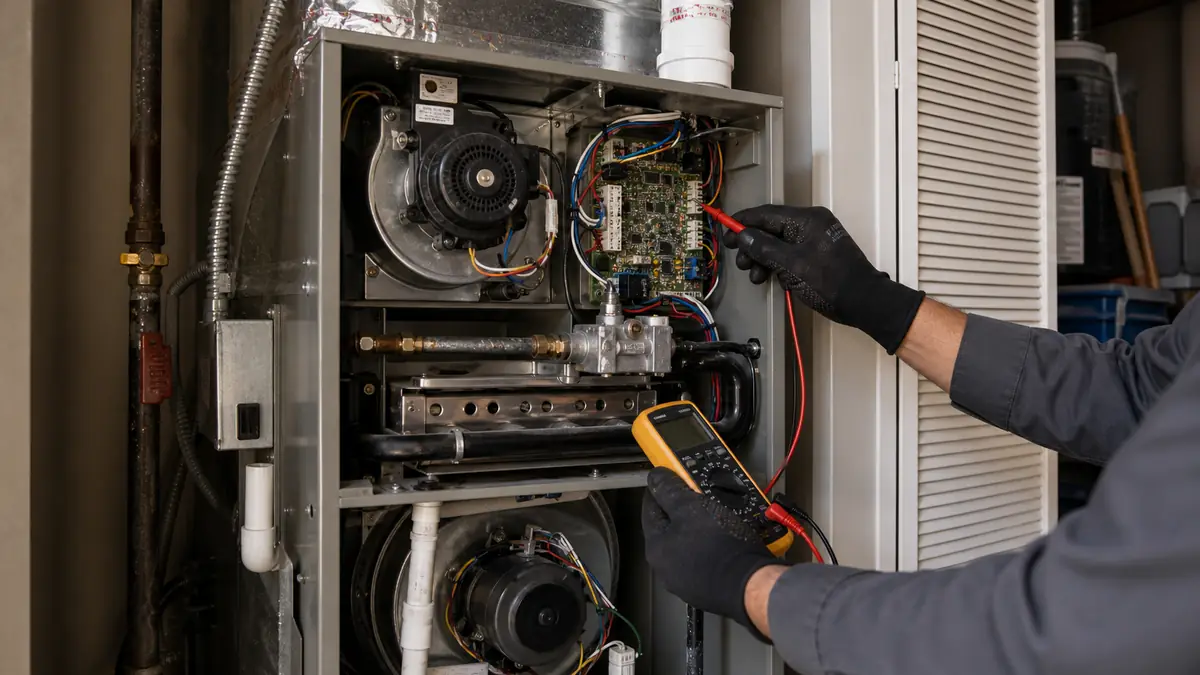
The work is a sequence, not a guess. We pull the burner-compartment door to drop the door switch, watch the integrated furnace control LED through the sight glass on a call for heat, and count the flash pattern against the Trane code chart. Then we follow the ignition sequence with a meter: confirm 24V to the inducer, verify the pressure switch closes once draft builds (a Magnehelic or manometer reads the negative pressure), check the hot-surface igniter resistance cold, and watch for the gas valve to open.
The proof step is flame sense. With a microamp meter in series on the flame-sensor lead, a healthy Trane furnace reads roughly 2 to 6 microamps; a sensor coated with oxide drops under 1 and the board drops gas on an 8-flash. We clean or replace the sensor, re-run the cycle, and confirm the burner stays lit, the blower energizes on the fan-on delay, and the high-limit does not trip. Last, we check temperature rise across the heat exchanger against the Trane nameplate range so we are not handing back a furnace that overheats on weak airflow.
Which Trane furnace families show up in Burbank?
Most Burbank cottages run an 80 percent furnace because the mild valley winter rarely justifies a condensing unit. The common lines we service:
- XR80 / XL80 / XV80 (80% AFUE): the budget tier and the workhorse of pre-war Burbank halls and closets. Single-stage XR80 and XL80 use a standard igniter and a simple pressure switch; the XV80 adds a variable-speed ECM blower for quieter, more even airflow.
- XR95 / S9X1 (single-stage 95-96% AFUE): condensing furnaces with a secondary heat exchanger and a condensate drain, so a 3-flash pressure-switch fault here is often a clogged condensate trap, not the switch.
- S9X2 / S9V2 (two-stage): the S9X2 runs a constant-torque ECM, the S9V2 a true variable-speed ECM at up to ~96% AFUE. These stage low for most of a mild day, so a no-heat call often traces to the control board or blower module rather than the burner.
- XV95 / XC95m (premium modulating): the XC95m modulates its gas valve and variable-speed blower up to ~97.3% AFUE. Repairs here run higher because the modulating valve and ECM module are the expensive parts.
What does Trane furnace repair cost in Burbank?
The cheap, high-frequency repairs dominate. A flame-sensor clean or swap runs $150 to $300, a hot-surface igniter $180 to $400, and a universal pressure switch $150 to $550. Those three close the majority of Burbank no-heat calls because the furnace sits idle most of the year and those parts fail from corrosion and the first cold-snap startup. A gas valve is mid-range at $250 to $700.
The big-ticket repairs are the ECM blower module on an XV80, S9V2, or XC95m at $400 to $2,300, and the integrated furnace control board at $400 and up. The repair conversation ends entirely at a cracked heat exchanger - a recurring 6-flash rollout or visible cracking - where the safe move is a full furnace replacement at $3,000 to $7,500, and California's Ultra-Low NOx rule applies to the new gas unit. All bands are approximate 2026 SoCal ranges; the diagnostic is about $139 and often credited toward the fix.
Which Trane furnace parts fail most on the valley floor?
The hot-surface igniter is the top wear item: brittle silicon nitride that cracks from thermal cycling and rough handling. Next is the flame sensor, a simple rod that needs cleaning when oxide blocks the micro-amp flame signal. Inducer motors seize after long idle stretches, and pressure switches fail closed or open when condensate backs up. On variable-speed S9V2 and XC95m units, the ECM blower module and modulating gas valve are the higher-dollar repairs.
We carry the common igniters, flame sensors, and universal pressure switches on the truck so a single visit closes most Burbank furnace calls. The board codes tell us what to stock before we knock.
When is a Trane furnace repair actually a replacement?
A repeated 6-flash rollout or any sign of a cracked heat exchanger ends the repair conversation - that is a safety replacement, full stop. Past 18 years, when an 80 percent unit needs a blower module plus a gas valve, the repair money is better spent on a high-efficiency furnace that meets California's Ultra-Low NOx requirement. We lay the thresholds out on the repair-or-replace guide and pair furnace replacement with a load calculation, since many Burbank furnaces were oversized decades ago.
What about the thermostat and airflow side?
Half of "furnace" calls are really airflow or control problems. A 4-flash high-limit trip usually means a clogged filter or a return choked by a closed door, not a bad furnace. A communicating XL850 or XL824 thermostat will surface a plain-language fault that a basic stat hides. We check the thermostat and controls and the duct and return path as part of any no-heat diagnosis.
Common questions about Burbank furnace repair
My Trane furnace flashes 3 times - what does that mean?
Three flashes on a Trane furnace control board points to a pressure-switch fault: the switch did not close or reopened during the call. Common causes are a blocked condensate or flue path, a weak inducer, or a cracked pressure hose. It is a safety lockout, not a part you should bypass.
Why does my Burbank furnace light then shut off after a few seconds?
That short-cycle on ignition is usually a dirty flame sensor. The board lights the burner, fails to prove flame because the sensor is coated, and drops gas as a safety. A flame-sensor clean or swap fixes most of these; an 8-flash low-flame-sense code confirms it.
Do I even run my furnace much in Burbank?
Not often. On the valley floor winters are short and mild, so a Trane 80 percent furnace like an XR80 or S9X1 sits idle most of the year, then gets asked to run on the first cold snap. That long dormancy is exactly when stuck inducers and corroded igniters surface.
Is it worth repairing an old 80 percent Trane furnace or upgrading?
If the furnace is under 12-15 years and the repair is a $200 igniter or $250 flame sensor, repair it. If the heat exchanger is suspect (a 6-flash rollout or visible cracking) or the unit is 18-plus years, price a high-efficiency replacement, and note CA Ultra-Low NOx rules apply to new gas furnaces.
My Trane furnace blows cold air, then shuts off. What is that?
If the burner lights but the blower never moves warm air, or the unit heats then trips, the usual cause is a 4-flash open high-limit from low airflow - a clogged filter, a closed return, or a failing blower. The furnace overheats and the limit drops gas as a safety. We fix the airflow restriction, not just reset the limit.
Is the diagnostic fee credited if I approve the furnace repair?
Usually yes. The roughly $139 diagnostic in 2026 SoCal is often credited toward the repair when you approve the work the same visit. We read the LED flash code and meter the ignition train so the quote is for the actual failed part, not a parts-cannon guess, and we confirm warranty status from the serial first.