Trane Furnace 7 Flashes in Burbank, CA
The homeowner answer: Seven flashes on a Trane furnace in Burbank, CA (ZIP 91505) is a gas-valve circuit error, so call rather than guess - the control board sees a fault in the gas-valve wiring or the valve coil itself, common after a long mild valley winter idles those parts. Book online or call (213) 805-8137 and a Trane tech meters it.
Quick facts
- 7 flashes = gas-valve circuit error: a fault in the valve wiring or the valve coil.
- Roughly half are wiring/connector/ground; half are the valve itself.
- Always metered before a valve is quoted - a reseated connector fixes many calls.
- Wiring repair often within a visit; a gas valve about $300-$700 installed.
- The code fails safe (no fire) - a leaking valve usually reads 5 flashes instead.
- Service ZIPs: 91501, 91502, 91504, 91505, 91506, 91523. Hours: Weekdays 7am-6pm, weekends 8am-2pm.
- Diagnostic about $139, usually credited toward the repair.
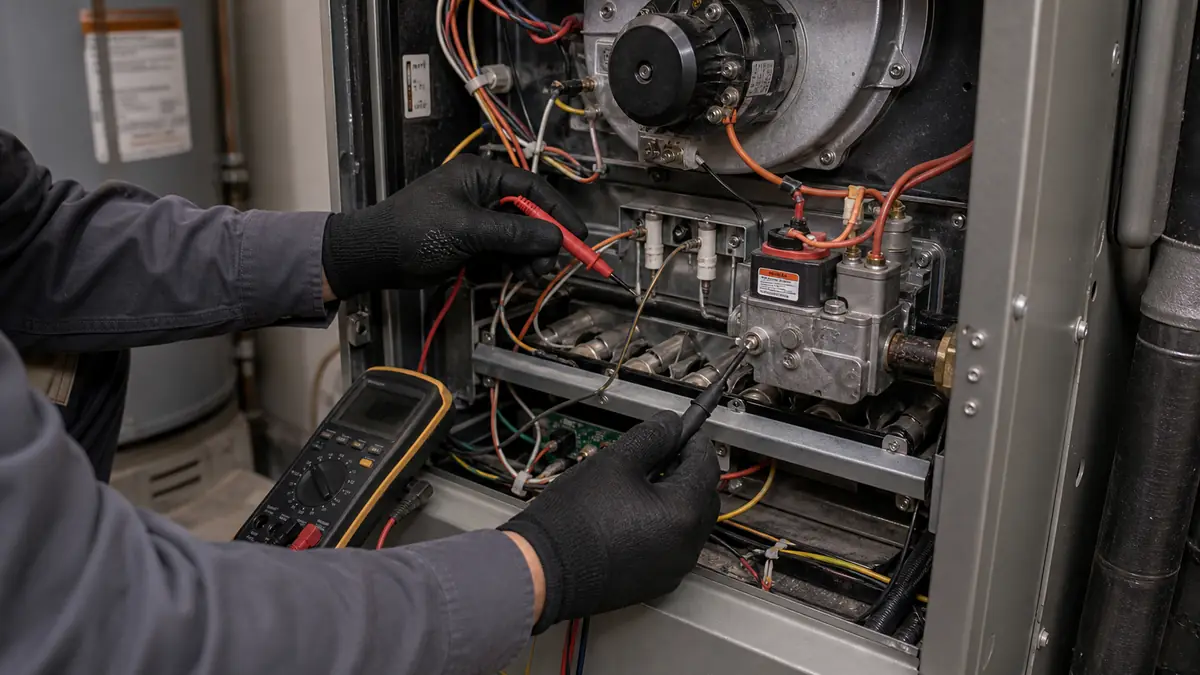
What does 7 flashes mean on a Trane furnace?
Seven flashes is a gas-valve circuit fault. The integrated furnace control (IFC) drives the gas valve with a low-voltage signal at the point in the ignition sequence where flame is supposed to light, and it monitors that circuit to be sure the valve is responding. A 7-flash means the board commanded the valve and the electrical circuit did not behave: an open or shorted valve coil, a broken or corroded wire between the board and the valve, a bad connector, or a grounding problem in that loop. Critically, this is a circuit complaint, not a "the valve leaked gas" complaint. The board is refusing to proceed because it cannot trust the valve, so it parks the code and keeps the gas off. That makes a 7-flash a fail-safe condition, not a hazard in itself - the danger would come from a homeowner forcing the valve open to "test" it. Because the fault lives in wiring as often as in the valve, the diagnosis is electrical first: you meter the circuit before you ever decide a part needs replacing.
Why does a Trane furnace show 7 flashes in Burbank?
Two things drive 7-flash calls on the San Fernando Valley floor: corrosion on idle connections and where these furnaces live. Burbank's Title-24 Climate Zone 9 heat-pocket climate means a furnace fires only a handful of cold mornings a year. The gas-valve plug, the harness, and the molex connector at the board sit unused from spring through fall. In a garage furnace - common in the post-war minimal-traditional and ranch tracts around Chandler Park - that connector breathes humid, sometimes salty garage air and dusty conditions all summer, and the contacts oxidize. The first heat call of the season pushes current through a now-resistive connection, the board reads the circuit as faulted, and out comes a 7-flash on equipment that ran fine the previous winter.
The older 1920s-1940s Spanish and Tudor cottages add their own version. Furnaces retrofitted into tight closets or low attics often have harnesses routed against sheet-metal edges; years of thermal expansion and the occasional rodent chew a wire or rub through insulation until it grounds or opens. And a valve coil that has cycled for two or three decades eventually drifts out of spec or opens internally. So in this city a 7-flash is usually an aging-connection story first and a worn-valve story second - which is exactly why metering beats guessing.
How do you diagnose a 7-flash gas-valve circuit?
The whole job is electrical detective work, done with the gas safely off until the circuit is proven. We confirm the repeating 7-flash, then split the circuit into wiring and valve and test each.
- Inspect and reseat connections. We pull the gas-valve connector and the board plug, look for green corrosion, melted pins, or backed-out terminals, and clean and reseat them. A surprising share of Burbank 7-flash calls end right here.
- Check the harness and ground. We follow the valve wiring for chafe, rodent damage, and breaks, and verify the furnace ground, since a poor ground can confuse the circuit monitor.
- Meter the valve coil. With power off, we read the coil's resistance against spec. An open coil reads infinite, a shorted one reads near zero - either condemns the valve.
- Verify the board's drive signal. On a heat call we confirm the board actually sends the commanded voltage to the valve terminals. Signal present with a good coil and good wiring but still a 7-flash points back at the control board.
- Confirm the fix under fire. After the repair we run a full heat cycle, watch the valve open and the burners light cleanly, and verify the code stays clear through several cycles.
Splitting the circuit this way is the difference between a connector reseat and a needless valve sale. We only condemn the gas valve when the coil or the board proves it, not because the code mentions the word "valve."
What is safe for a homeowner versus a pro on a 7-flash?
The safe-homeowner list here is short, because this code lives inside the gas train. You can confirm the thermostat is calling for heat, check that the furnace switch and breaker are on, and verify the gas shutoff at the furnace is in the open position and the gas is on at the meter. You can read and record the flash count. That is the boundary. Everything past it - opening connectors, metering the valve coil, probing the harness, and certainly anything involving the gas valve body or gas piping - is pro-only, because it combines line-voltage and low-voltage circuits with live gas piping. Never jump the valve, never force it open to "see if it works," and never run the furnace with the lockout bypassed. And if you ever smell gas at all, stop, leave the furnace off, get fresh air into the space, and call - a gas odor is not a code to troubleshoot, it is a leave-and-call situation.
How urgent is a 7-flash, and what will it cost in Burbank?
Urgency first: a 7-flash is a no-heat condition, not a safety emergency on its own, because the board is keeping the gas off. On a mild Burbank night that means a same-week scheduled repair is usually fine. It escalates only if a vulnerable household loses heat during a real cold snap - then see emergency service in Burbank - or if you smell gas, in which case it stops being a furnace-code question entirely. On cost, the split decides the bill. A wiring, connector, or ground repair frequently falls inside the roughly $139 diagnostic, which is usually credited toward the work. A replacement gas valve runs about $300 to $700 installed in 2026, parts and labor, and a failed control board lands higher, around $400 to $900. If the furnace is past about 18 years and the valve failure rides along with other worn parts, weigh the repair-or-replace guide, since a new California furnace must meet Ultra-Low NOx rules. To compare this against the other codes your furnace can throw, go back to the Trane error-code hub, and the furnace repair page covers parts and labor in depth. Read your flash count, then call (213) 805-8137 or book online.
Common questions about a Trane 7-flash in Burbank
Is a 7-flash on a Trane furnace just a bad gas valve?
Not always. A 7-flash gas-valve circuit error means the control board cannot drive or confirm the valve, and that splits roughly in half: about half are wiring - a corroded valve connector, a chafed harness, or a poor ground - and about half are the valve coil itself. We meter both before quoting a valve, because a $0 connector reseat fixes a lot of 7-flash calls.
Can a 7-flash Trane furnace leak gas?
The code itself is the board refusing to open or hold the valve, so it is failing safe, not leaking. The real gas-safety concern is the opposite scenario, a valve that leaks by when it should be shut, which usually shows as a 5-flash, not a 7. Still, if you ever smell gas, leave the furnace off, ventilate, and call - do not troubleshoot a gas odor.
Why did my Trane throw 7 flashes after sitting all summer?
Low runtime is the pattern. A Burbank furnace fires only a few dozen hours a year, so the gas-valve connector and harness sit in a garage or attic corroding through the warm months. The first cold call puts current through a marginal connection, the board sees the circuit fault, and you get a 7-flash on a furnace that worked fine last March.
What does a 7-flash repair cost in Burbank?
It depends on which half it is. A wiring or connector repair - reseating or replacing a corroded valve plug, fixing a chafed harness, or correcting a ground - often lands inside the roughly $139 diagnostic visit. A replacement gas valve runs about $300 to $700 installed in 2026, parts and labor, more on older or specialty valves.