Smart and ComfortLink Thermostat Installs in Burbank
The homeowner answer: Burbank Trane HVAC installs smart and Trane ComfortLink II thermostats across Burbank, CA from Toluca Lake-adjacent streets to Burbank Hills in ZIPs 91501 to 91523, wiring XL850 and XL824 communicating controls and handling the missing C-wire on old bungalows, so call (213) 805-8137 or book online to schedule a tech, with installs typically $150 to $700 by control.
Quick facts
- Controls installed: standard smart stats, Trane XR724, XL624, XL824, XL850.
- ComfortLink II is required to stage XV20i, XV18, and XL two-stage equipment.
- Pre-war Burbank homes often lack a C-wire; we add one cleanly.
- Thermostat installs typically $150-$700 in 2026 SoCal, control depending.
- Service ZIPs: 91501, 91502, 91504, 91505, 91506, 91523.
- Hours: Weekdays 7am-6pm, weekends 8am-2pm.
- Independent; in-warranty Trane controls referred to the authorized dealer first.
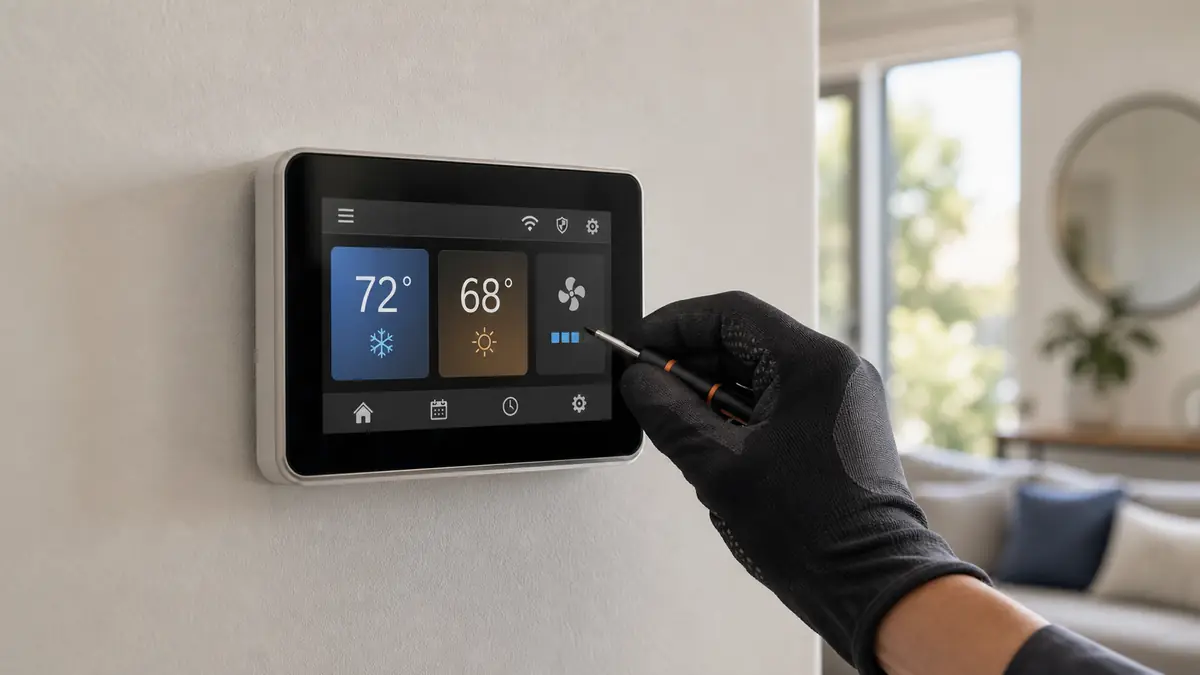
What makes thermostat installs tricky in old Burbank homes?
The wiring. Burbank's 1920s-1940s cottages were built for a heat-only system on two or three wires, with no common (C) wire to power a modern display. Drop in a Nest or Ecobee and it either won't hold a charge or it nuisance-cycles the furnace by power-stealing through the control board. We solve it properly: pull a new conductor through the original chase, add a fused add-a-wire adapter, or confirm the furnace board can supply a clean C.
The second issue is matching the control to the equipment. A communicating Trane system is only as smart as the thermostat that talks to it. A third Burbank wrinkle is placement: many pre-war cottages have the original stat on an interior hallway wall far from the living space, or near a kitchen doorway, so it reads a temperature the bedrooms never feel. When we swap the control we check that location and, where it makes sense, relocate the stat or lean on a remote sensor so the system targets the rooms you actually occupy rather than a warm hallway.
| Your Trane equipment | Right control | Why |
|---|---|---|
| Single-stage XR13/XR14/XR16 + 80% furnace | Smart stat or XR724 | One stage; no communicating need |
| XR402 / basic heat-cool setup | XR402 or any 24V smart stat | Conventional 24V; needs only a C-wire |
| XL18i two-stage AC or heat pump | XL824 or XL850 | Stages low/high; communicating |
| XV18 variable-speed | XL824 or XL850 (ComfortLink II) | Modulates Climatuff; plain-language alerts |
| XV20i variable-speed | XL850 (ComfortLink II) | Top-tier modulation, Nexia/Z-Wave hub |
How do you install a thermostat in an old Burbank house?
The work starts at the furnace board, not the wall. We kill power, pull the existing stat, and identify the conductors landed at the air handler - on a pre-war Burbank cottage that is often just R, W, and G with no common. To power a modern display we either pull a fresh 18/5 or 18/8 thermostat cable through the original chase, land a fused add-a-wire adapter at the board to repurpose an unused conductor, or, on a true communicating system, run the full 4-wire ComfortLink II bus to both the air handler and the condenser.
Then we configure and prove it. We set the equipment type and staging in the thermostat menu, verify the C terminal reads a clean 24 to 28 volts AC at the stat, and run each mode - cool, heat, fan, and on a two-stage or variable-speed system the low and high stages - confirming the call reaches the unit and the staging actually changes. On a communicating XL850 or XL824 we pair the indoor and outdoor boards and confirm no loss-of-communication alert before we leave.
Which Trane and smart controls do you install?
We match the control to the equipment tier:
- XR402 / XR724: non-communicating programmable and Wi-Fi stats for single-stage XR condensers and 80 percent furnaces - all most small Burbank homes need.
- Standard smart stats (Nest, Ecobee class): fine on conventional 24V single-stage systems with a proper C-wire; they will not stage a communicating Trane unit.
- ComfortLink II XL824 (TCONT824): communicating color touchscreen with Wi-Fi and Nexia, the right control for XL18i two-stage and XV18 variable-speed systems.
- ComfortLink II XL850 (TCONT850): the top control with a built-in Nexia bridge and Z-Wave, required to fully run an XV20i and surface plain-language faults.
What does a thermostat install cost in Burbank?
A straightforward swap with an existing C-wire - dropping in a smart stat or an XR724 on a single-stage system - runs roughly $150 to $300. Add a C-wire to a pre-war home that lacks one, by pulling a conductor or fitting an add-a-wire kit, and it moves to $250 to $450 because the labor is at the furnace board and through tight original chases. A communicating ComfortLink II XL824 or XL850 install on a two-stage or variable-speed system lands at $400 to $700 with the control included, since it requires the 4-wire bus and board pairing. All are approximate 2026 SoCal ranges.
What does ComfortLink II actually do?
ComfortLink II is Trane's 4-wire communicating protocol. The XL850 and XL824 color touchscreens unlock variable-speed and two-stage staging, integrate with Nexia and Z-Wave, and replace cryptic blink codes with plain-language fault text - for example a loss-of-communication alert with the outdoor unit that also shows in the Trane Home app. On a Trane XV20i system, the control is not optional; it is what makes the variable-speed comfort work.
What does the right control actually change day to day?
On a single-stage system, a smart stat mostly buys you scheduling, geofencing, and remote control - useful, but the equipment still runs full-on or off. On a two-stage XL18i or a variable-speed XV18 or XV20i, the communicating XL824 or XL850 is what unlocks the comfort you paid for: it tells the Climatuff compressor to hold a low stage and run long, which on the Burbank valley floor means quieter operation, fewer temperature swings, and real dehumidification through a 95 F afternoon instead of the blast-then-coast cycle of a single-stage unit.
The other day-to-day gain is diagnostics. A basic stat hides a developing fault until the system quits; the XL850 surfaces a plain-language alert - a loss of communication with the outdoor unit, for instance - and logs it to the Trane Home app, so a marginal connection gets caught before it strands you. We set the cycle rate and staging thresholds during the install so the control matches how the equipment is meant to run, not a generic factory default.
Can a thermostat fix a comfort complaint by itself?
Sometimes. A correctly placed, correctly wired stat with proper cycle settings can end the temperature swings on a single-stage system. But if the house has hot far rooms, the real cure is usually duct and return work, not a smarter thermostat. We tell you which one you actually need rather than upselling a control that papers over an airflow problem.
Common questions about Burbank thermostats
My 1930s Burbank house has no C-wire - can I still run a smart thermostat?
Usually yes. Pre-war Burbank cottages were wired for simple heat-only stats, so there is often no common wire at the furnace. We either pull a new conductor, add a fused add-a-wire kit, or wire a power-stealing model, then verify the furnace board powers the stat cleanly.
Will a Nest or Ecobee unlock my Trane XV20i two-stage cooling?
No. A generic smart thermostat runs a Trane XV20i or XV18 as a single-speed unit. Only the matched ComfortLink II control - the XL850 or XL824 - speaks the communicating protocol that stages the Climatuff compressor and surfaces plain-language fault alerts. If you bought variable-speed, use the matching control.
Which Trane thermostat should I pick for a small Burbank home?
For a single-stage XR condenser and an 80 percent furnace, a standard smart stat or the XR724 is plenty. For two-stage or variable-speed Trane equipment, step up to the XL824 or XL850 so the staging and Nexia/Z-Wave features actually work. We match the control to the equipment, not the marketing.
Why does my thermostat say cooling but the Burbank house stays hot?
If the stat calls and the condenser never starts, the issue is downstream - a failed capacitor, contactor, or a tripped float switch on the condensate line - not the thermostat. We confirm the call reaches the unit, then chase the real fault rather than swapping a stat that works fine.
Can a smart thermostat lower my Burbank cooling bill?
Modestly, through scheduling and geofencing. On a single-stage system a smart stat trims runtime by not cooling an empty house, which matters over 40-55 days a year above 90 F. But the bigger savings on the valley floor come from sealing leaky ducts and right-sizing the equipment, not from the control alone. We tell you which actually moves your bill.
Will a power-stealing smart thermostat damage my Trane furnace?
It can cause nuisance problems. A power-stealing stat with no C-wire pulls current through the furnace control board to charge itself, which on some boards causes ghost calls or short-cycling. On a Trane system we prefer to add a true common conductor so the stat has clean 24V power and the board sees only real calls for heat or cool.